

A Guide to Understanding How to Care for Your Curls
When it comes to your hair, you always want to be able to put your best curls forward. This might mean investing a little extra time and effort into how you care for them. Caring for curly hair can easily become time-consuming. So what can you do to make the process as easy as possible?
Some important factors, like your hair’s porosity, can affect how defined, healthy, and consistent your hair is daily. In its most simple form, hair porosity defines how well (or not) your curls absorb and retain moisture. So before you even buy hair products or start researching different hair care methods, it might be beneficial to you to understand more about how your hair interacts with moisture.
What is hair porosity?
So we have already established that hair porosity is your hair’s relationship with moisture. It helps to understand how well your hair follicles absorb water when you wash and style it. It also determines how well your hair locks in that moisture. This just means how quickly your hair might lose moisture between washes.
Each hair follicle on your head is naturally coated in shingle-like cuticles. These cuticles act as a shell on the outer layer of your hair. When they are open, your hair can absorb moisture into the follicle. When closed, they act as a barrier that traps moisture, helping maintain strong and healthy hair. There are three ways to categorize and begin understanding your hair’s porosity. There is high porosity hair, medium porosity hair, and low-porosity hair.
High Porosity Hair
High porosity hair covers curls that can easily absorb water. Opening your hair’s outer layer to allow moisture in is a relatively simple process. If your hair falls under this category, you might struggle most with retaining moisture. This is due to the same factors that make it so easy to absorb. Since your hair follicles open up easier, you want to focus on locking in moisture. This hair type also tends to be a bit more frizzy and tangles more easily.
Medium Porosity Hair
Medium porosity hair is more or less recognized as “normal porosity.” It can vary slightly among curls that fall in this category, but for the most part, medium porosity hair tends to absorb moisture pretty well. Inversely, it does not lose moisture too quickly. Making maintenance for this hair category is the most simple out of the three. The best you can do for medium porosity hair is to maintain a consistent hair regimen. This will keep the moisture in your hair at a healthy balance. Just because it’s easier to maintain doesn’t mean you should not focus on healthy moisturizing habits.
Low Porosity Hair
Low porosity hair has the most difficulty opening up. It’s hard for water or other moisturizing products to penetrate your curls. These hair types are often referred to as waterproof because they literally defy water. In cases of low-porosity hair, you can completely drench the hair in water and still come out with dry or semi-dry hair. These hair types need to focus on opening up the hair cuticle. They also work well with deep-conditioning treatments because it gives the hair more time to absorb moisture.
Other factors that can affect hair porosity
It’s important to note that outside factors can also affect your hair’s ability to absorb moisture. Anything that could potentially affect the hair shaft long term has this ability. Some factors are in your control, while others come from your environment and are out of your control. Nevertheless, if you know that any of these apply to your hair, it will help in your search to understand your hair’s porosity. Some of those factors include:
● Heat damage (flat irons, blow dryers, curling wands, etc.)
● chemical styling (relaxers, perms, hair dyes, etc.)
● exposure to high or low temperatures (hot water, cold water, summer sun, winter air, etc.)
● Environmental factors (humidity, aridity, etc.)
Conclusion
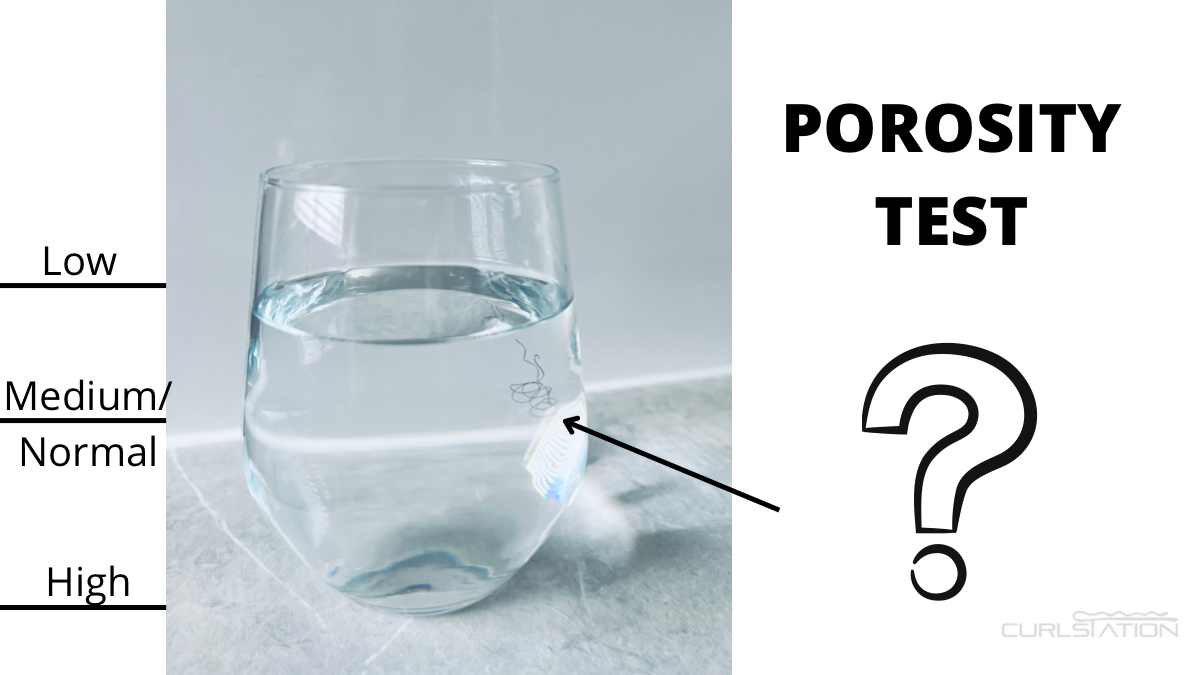
Some people believe you can test your hair’s porosity to understand where you might land in the three categories discussed. A popular hair porosity test is dropping a piece of hair into a glass of water. Then you wait a few minutes and pay attention to how your hair interacts with the water. If your hair sinks quickly, this means that your hair has a higher porosity. If it sinks slowly, then it tends to have medium porosity. If the hair follicle stays at the top of the glass even after a few minutes, your hair has a lower porosity.
This test might be less accurate than you want to believe. While it can tell you a little about your hair, it can also be easily done wrong. If the water is warm or cold, this can affect the accuracy of the test. Also, if you have manipulated your hair in any way, your hair might have different porosity along the hair follicle. Another point is that if you have different curl patterns around your head, this test may only indicate the results of a fraction of your head.
It’s best to think about how your hair reacts when you take a shower or jump into a body of water. Understanding your hair’s porosity can be difficult, but over time you will be able to build a strong hair care regimen. Taking the first step to understand your curls is intimidating, but it will be rewarding in the long run.